
Why TAFEs Need a Cyber Range
TAFEs are at the front line of Australia's cybersecurity skills pipeline. Programs like the Certificate III in Information Technology, Certificate IV in Cyber Security (22603VIC), Diploma of IT (Cyber Security), and Advanced Diploma pathways are producing job-ready graduates who go straight into SOC analyst, security operations, and incident response roles.
But delivering genuinely practical cybersecurity training is hard without the right infrastructure. Building and maintaining physical labs is expensive and time-consuming. Shared VM environments create conflicts between students. Free tools like VirtualBox require local setup that eats into class time. And getting students access to real enterprise-grade security tools — SIEMs, packet analysers, penetration testing frameworks — often means navigating licensing complexity that TAFE IT departments aren't resourced to handle.
Security Impossible's cyber range removes all of that. Every student gets their own dedicated virtual machine, pre-loaded with industry-standard tools, accessible through a browser, and ready to go with a single click from the instructor. No local setup. No shared environments. No licensing headaches.
How the Cyber Range Supports TAFE Delivery
Competency-Based Lab Design
Labs are structured to support competency-based training and assessment. Each lab maps to specific skills and knowledge outcomes — so when a student completes a penetration testing lab, you have clear evidence they've demonstrated the required competency, not just that they attended a session.
Aligned to Cert III, Cert IV, Diploma, and Advanced Diploma
Lab modules cover the practical domains addressed across TAFE cybersecurity qualifications — from foundational networking and system administration at Cert III level through to incident response, threat detection, and SOC operations at Cert IV and Diploma level.
Industry-Standard Tools, Not Academic Abstractions
Students work with real tools used in cybersecurity roles: Wireshark, Nmap, Metasploit, Burp Suite, Elastic, Sigma rules, and many more. When they walk into a junior SOC analyst role, they've already used the tools their employer expects.
One-Click Class Deployment
An instructor can deploy a fully configured lab environment for an entire class in a single click. Every student gets their own isolated VM, pre-loaded and ready. No 20-minute setup at the start of every session.
Instructor Dashboards and Progress Tracking
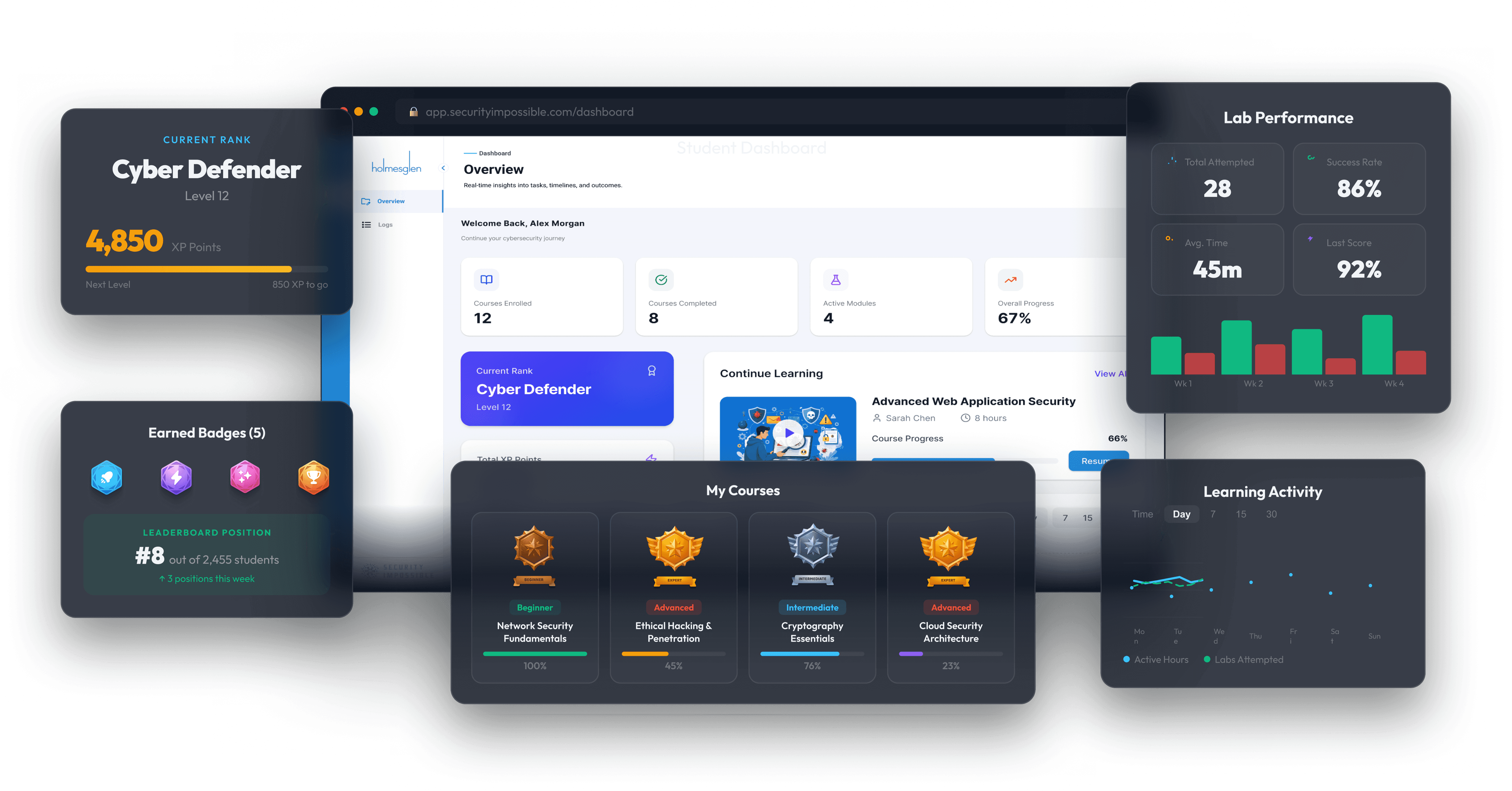
See which students have completed each lab, how many attempts they've made, time spent, and where they're getting stuck. This data supports both formative assessment and summative evidence for competency sign-off.
Quizzes and Scoring Built In
Knowledge checks and quiz questions sit alongside the practical lab tasks in a single interface. Students don't need to switch between a lab environment and a separate LMS.
Browser-Based Access — Works on Any Device
Students access their lab environment through a browser. No VPN, no local software installs, no minimum hardware specs beyond a browser and internet. Works on campus PCs, BYO laptops, or Chromebooks.
Repeatable Labs for Skill Reinforcement
Cybersecurity skills need practice. Students can repeat any lab as many times as they need. Sandbox mode provides an open environment for experimentation beyond guided exercises.
Lab Domains for TAFE Programs
Lab content is designed to be practical and job-focused. Students aren't reading about attack techniques — they're executing them in a safe, monitored environment.
Supporting Free TAFE Cybersecurity Programs
Cybersecurity qualifications — including the Certificate III in Information Technology and Certificate IV in Cyber Security — are part of the Australian Government's Free TAFE initiative across multiple states. This has driven a significant increase in enrolments.
Security Impossible's cyber range is built to scale with this demand. Cloud-hosted infrastructure means you don't need to buy more hardware. Adding a new cohort is as simple as creating a new class in the instructor dashboard.
From TAFE to University — Supporting Pathway Students
Many TAFE cybersecurity students progress to university programs — from Certificate IV or Diploma into a Bachelor of Cyber Security or Bachelor of IT (Security). The skills and tool familiarity they build on the cyber range carry directly into their university studies.
For TAFEs with established university articulation pathways, the cyber range ensures continuity in the practical learning experience. Students aren't starting from scratch — they've already spent hundreds of hours in real lab environments.
Add a Training SOC to Your TAFE
For TAFEs delivering Diploma or Advanced Diploma programs that include SOC operations content, Security Impossible offers TSOC — a Training Security Operations Centre that can be deployed alongside the cyber range.
TSOC gives students a real SOC experience: SIEM dashboards, log ingestion from multiple sources, live detection scenarios, alert triage workflows, and incident reporting. It's the closest thing to a working SOC that a TAFE can offer without building one from scratch.