
The Challenge for University Cybersecurity Programs
Australian universities are producing the next generation of cybersecurity professionals — but the gap between lecture-based theory and real-world capability remains one of the sector's biggest challenges.
Building and maintaining physical lab infrastructure is expensive, slow to update, and difficult to scale across cohorts. Students graduate with knowledge of frameworks and concepts but limited hands-on experience with the tools and environments they'll encounter in industry — SIEM platforms, penetration testing toolkits, forensic analysis workflows, and Security Operations Centre (SOC) procedures.
Employers consistently report that graduates need additional on-the-job training before they can contribute effectively. The challenge isn't curriculum design — it's the practical delivery layer that brings that curriculum to life.
Security Impossible's cyber range solves this by providing a cloud-hosted, browser-based lab platform that gives every student their own dedicated virtual machine environment — pre-configured, curriculum-aligned, and ready to deploy in a single click.
How the Cyber Range Works for University Programs
Dedicated Virtual Machines Per Student
Every student gets their own isolated VM environment — no shared resources, no configuration conflicts. Students work independently on real operating systems with real tools, exactly as they would in a production environment.
Curriculum-Aligned Lab Modules
Labs are mapped to common university cybersecurity curriculum areas including network security, penetration testing, digital forensics, malware analysis, incident response, and SOC operations. Modules align to topics covered in Bachelor of Cyber Security, Bachelor of IT (Security), and Master of Cyber Security programs delivered across Australian universities.
One-Click Class Deployment
Instructors deploy an entire cohort's lab environment with a single click. No manual VM provisioning, no pre-class setup time, no IT support tickets. Environments are ready when your students walk in — or log in for remote delivery.
Instructor Dashboards and Analytics
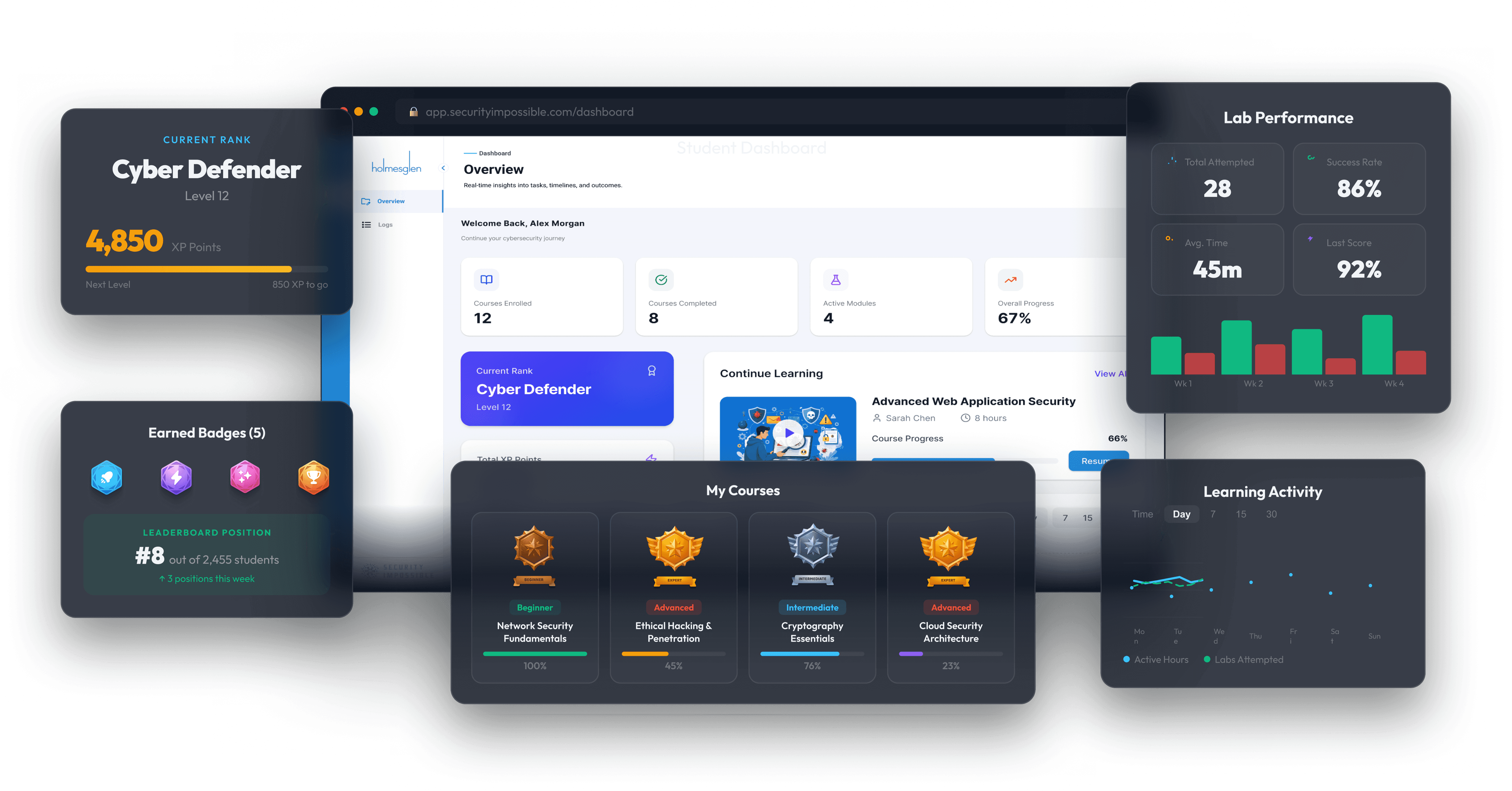
Track student progress in real time. See who has completed each lab, how many attempts they've made, where they got stuck, time spent per task, and cohort-wide performance trends. Use this data for formative assessment, identifying at-risk students, and reporting to program leadership.
Quizzes, Scoring, and Assessment
Built-in quizzes and scoring sit alongside the lab environment in a single interface. Students complete practical tasks and answer assessment questions without switching tools. Results feed into the instructor dashboard for grading and evidence of competency.
Repeatable Labs and Sandbox Mode
Students can repeat labs as many times as they need. Sandbox mode provides open-ended environments for self-directed exploration, research projects, and capstone work — without risk to production systems or other students' environments.
Browser-Based — No Downloads, No Local Setup
Students access their lab environment through any modern browser. No VPN clients, no local VM software, no minimum hardware requirements beyond a browser and an internet connection. This makes the platform accessible for on-campus, remote, and hybrid delivery models.
Secure and Isolated Environments
All lab environments are monitored, isolated, and sandboxed. Students can safely execute attack techniques, run malware samples, and conduct penetration tests without any risk to the university network or other students.
Lab Domains Covered
Penetration Testing
Digital Forensics
Malware Analysis
Network Security
SOC Operations & Triage
Incident Response
Web Application Security
Cryptography & Secure Communications
Detection Engineering
Capture the Flag (CTF) Challenges
Each domain includes guided walkthroughs, instructor notes, learning outcomes, and assessment rubrics. Labs range from introductory (suitable for first-year undergraduates) to advanced (suitable for Master's students and research contexts).
For universities delivering advanced cybersecurity programs — particularly at Master's level or through dedicated SOC analyst pathways — Security Impossible also offers TSOC: a fully operational Training Security Operations Centre.
TSOC provides students with a real SOC environment including SIEM and log ingestion pipelines, live telemetry from Windows, Linux, and network sources, detection engineering scenarios using Sigma and KQL patterns, and end-to-end incident response workflows from alert triage through to reporting.
TSOC can be deployed alongside the cyber range to provide the most comprehensive hands-on cybersecurity learning ecosystem available for Australian universities.